
Deep cut
Friday, October 23, 2026
The night the furnaces went cold
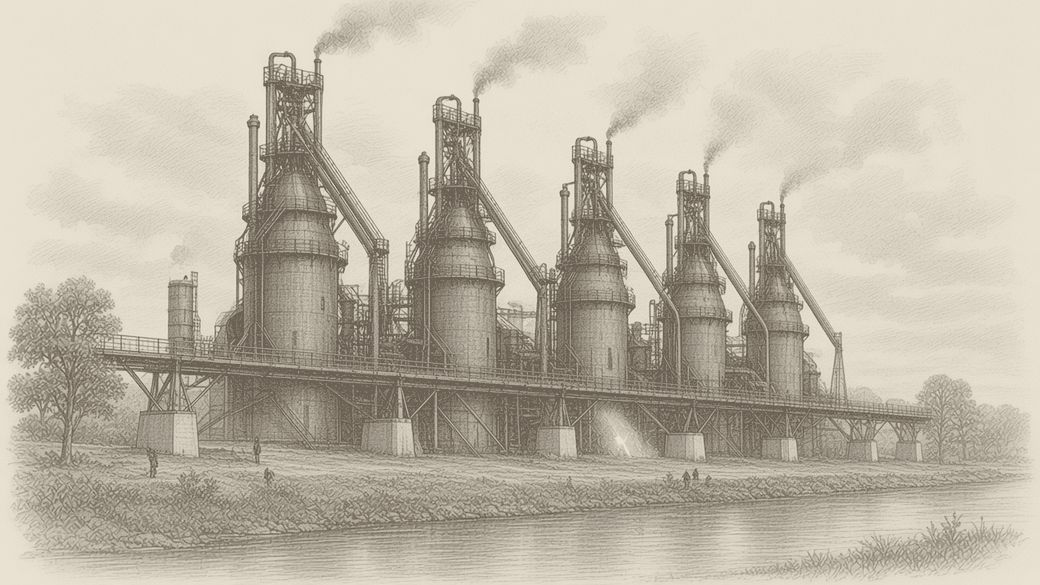
I've been to SteelStacks more times than I can count, and for years the blast furnaces were just the backdrop, the big rusty thing that looks great lit up at night. Then one weekday afternoon I had an hour to kill and walked up onto the Hoover-Mason Trestle by myself.
I've been to SteelStacks more times than I can count, and for years the blast furnaces were just the backdrop, the big rusty thing that looks great lit up at night. Then one weekday afternoon I had an hour to kill and walked up onto the Hoover-Mason Trestle by myself. It was just me and those towers, close enough to see the rivets, and a row of signs telling you what happened here.
I came down feeling like I'd been in somebody's house without knowing they used to live there. So here's the story of the furnaces at SteelStacks, told the way the trestle tells it.
Iron on the South Side
The furnaces at SteelStacks are the last chapter of a South Bethlehem ironworks that goes back to the Civil War. In 1857 a company was organized to make iron in Bethlehem, and after a move to South Bethlehem and a couple of name changes it became the Bethlehem Iron Company in 1861. Construction on its first blast furnace started on July 1 of that year, and the furnace went into blast on January 4, 1863. That September, the company rolled its first railroad rails.
Before it was steel, it was iron, and the iron went into rails for a country laying track as fast as it could. A second blast furnace followed in 1867.
Guns, armor, and a Ferris wheel
By the 1880s the iron works along the Lehigh had a new customer: the U.S. Navy, which was rebuilding its fleet with steel-hulled warships. Bethlehem Iron won forging and armor contracts in 1887 and built the country's first heavy-forging plant between 1888 and 1892, designed by John Fritz.
My favorite detail from this era has nothing to do with war. For the 1893 Chicago World's Fair, Bethlehem Iron supplied the steel for the 45.5-foot axle that held up the world's first Ferris wheel. Iron from the company's blast furnaces was turned into steel and then forged into what was, at the time, the largest single steel forging ever made. Every carnival Ferris wheel in the valley owes this riverbank a little something.
The steel years
In 1899 the owners formed Bethlehem Steel Company, and in 1904 Charles M. Schwab put together Bethlehem Steel Corporation and became its first president. Under that name the furnaces on the South Side became part of one of the biggest steelmakers in the world.
In 1908 the company started rolling Grey beams, wide-flange structural steel based on Henry Grey's design. Those beams helped kick off the skyscraper age. Bethlehem steel went into the Empire State Building and Rockefeller Center, plus the Golden Gate Bridge and the George Washington Bridge. During both world wars, the company turned out armor plate and big guns for the military, and its shipyards built more than 1,100 ships during World War II.
Historic Bethlehem says that at its height, the Bethlehem plant ran 24 hours a day and employed more than 30,000 people. Think about that the next time you're looking for parking on Third Street.
The trestle that fed them
The walkway you're standing on when you visit the furnaces at SteelStacks has its own story. The Hoover-Mason Trestle is an elevated rail line, named after the engineering firm that designed and built it, and it was in use from 1907 until 1995.
According to the SteelStacks marker on the trestle, electric transfer cars brought iron ore and limestone to the furnaces from a storage yard about half a mile east. Coke came in hopper cars from the company's Coke Works near Hellertown. Each car could carry about 150 tons of material, and they ran back and forth along the trestle 24 hours a day, 365 days a year. The furnaces never got a day off, so the trestle didn't either.
The last cast
The SteelStacks marker called "Why Did Bethlehem Close?" lays out what changed. Aluminum and plastic started replacing steel. Foreign mills and American mini-mills started competing hard in the 1960s. A recession in the early 1980s shrank profits further. The marker notes that many people blame management for responding poorly, and some point to union demands on wages and pensions. That argument is still going on at kitchen tables around here, and I'm not going to settle it in a newsletter.
What isn't in dispute is the date. On November 18, 1995, workers cast Blast Furnace C for the last time. Families gathered to watch the last pour. The Steelworkers' Archives calls the shutdown of the hot end "a profound event for steelworkers, the Bethlehem Steel Corporation, and the entire community." The marker says the cooling of the furnaces started a phased shutdown, and by 1998 all operations at the Bethlehem plant had ended.
There's a quote on that marker from Dave Swartz, a beam yard saw operator, about the day the last cut was made: "And that was the first time we heard the mill silent." I read it standing next to the furnace it's talking about, and I had to take a second.
The corporation filed for bankruptcy in 2001 and was dissolved in 2003. Its old headquarters, Martin Tower in West Bethlehem, came down in 2019.
What the furnaces became
The furnaces at SteelStacks could have been torn down. Instead, five of them were left standing, rust and all, as the centerpiece of what's there now. In 2007 the property was sold to Sands BethWorks, which built a casino that opened in 2009 (it's Wind Creek now). ArtsQuest built its arts campus around the furnaces, and the Hoover-Mason Trestle reopened as an elevated walkway on June 25, 2015.
So the same rail line that hauled ore around the clock is now where people walk their out-of-town relatives at sunset. I think the steelworkers would find that a little funny. I hope they'd find it a little nice, too.
How to see the furnaces
The easiest way is to just go. The Hoover-Mason Trestle is open Sunday through Wednesday from 10am to 8pm, and Thursday through Saturday from 10am to 9pm, according to ArtsQuest. It can close for bad weather or special events, so call 610-332-1300 if the sky looks iffy. Entrances are at the Bethlehem Visitor Center and at either end of the Gas Blowing Engine House. Read the markers on the way up.
If you want a guide, Historic Bethlehem Museums & Sites runs The Rise & Fall of Bethlehem Steel walking tour at 1pm on Fridays, Saturdays, Sundays, and Mondays. It leaves from the ArtsQuest Visitor Center at 711 East First Street, runs about 90 minutes, and costs $20. The tour description says the furnace complex is nearly a quarter mile long and more than 230 feet tall, which feels about right when you're standing at the bottom of it.
Go on a weekday if you can. It's quiet up there, and you'll get some idea of what Dave Swartz meant.