
Deep cut
Tuesday, November 3, 2026
The ironmaster of Catasauqua
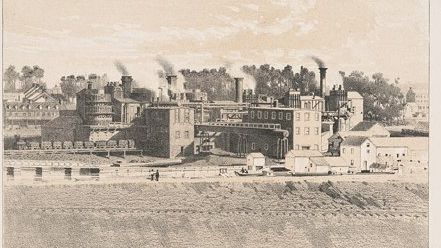
Catasauqua is one of those towns a lot of us drive through on the way to somewhere else, down Front Street with the river and the old canal off to one side. For years I had no idea that stretch of Front Street is where the American iron business took a big step forward.
Catasauqua is one of those towns a lot of us drive through on the way to somewhere else, down Front Street with the river and the old canal off to one side. For years I had no idea that stretch of Front Street is where the American iron business took a big step forward. The man who made it happen was a Welsh ironmaster named David Thomas, and he was born on Nov 3, 1794. So today, the day this lands in your inbox, is his birthday.
A problem nobody could crack
In the 1830s, the Lehigh Coal and Navigation Company had a lot of anthracite coal coming down the Lehigh and not enough ways to use it. Anthracite is hard coal, and the state's history site says other ironmasters had tried to make iron with it and gotten little or nothing for their trouble.
Over in Wales, Thomas had spent years running blast furnaces at the Ynyscedwyn ironworks, where, according to the Dictionary of Welsh Biography, he experimented with anthracite as a smelting fuel and got it to work. That's what the Lehigh company wanted. The state's history site says Erskine Hazard, one of the company's founders, went to Britain and recruited him.
Thomas came over in 1839 and, by the Historic Catasauqua Preservation Association's account, arrived in what's now Catasauqua that July and started building a furnace right away. It went up beside the Lehigh Canal, at Lock 36, which the preservation group places between the Race Street and Pine Street bridges.
July 4, 1840
The furnace for the Lehigh Crane Iron Company made its first iron on July 4, 1840. The Pennsylvania state historical marker on Front Street calls it "the first long-term, commercially successful anthracite iron furnace," and the preservation association, Wikipedia and the state's history site all tell the same story. A Fourth of July start for an American iron town is almost too neat, but every source agrees on the date.
The state's history site says that first furnace made 1,088 tons of pig iron in its first six months, with a best week of 52 tons, which was far more than a typical charcoal furnace could turn out. The company kept building. The marker says that by 1868 the works had six furnaces. The canal carried in the coal and the iron ore, and the preservation association says it stayed the main supply route until the railroad reached Catasauqua in 1868.
A town built around the furnace
The iron works didn't sit in an existing town so much as make one. The preservation association describes Thomas running it as a company town in the British style, where the company provided the houses and much of the civic life. It says he laid out streets and built the first company homes along Wood and Church Streets, two-story houses of brick and frame with slate roofs. He helped found the town's first church, a Presbyterian congregation, in 1840, and both Wikipedia and the preservation association credit him with organizing the first fire company. Welsh furnace workers followed him over, and the association describes the rows of company homes as a Welsh neighborhood in the middle of German farm country.
The name came later. The borough took the name of the Catasauqua Creek, from a Lenape word usually translated as thirsty ground or dry ground. Which is a funny name for a town that sits on a river and a canal, built around a furnace that ran on water power when it started.
Thomas stayed for the rest of his life. The preservation association says he built a large home in 1856 at the southeast corner of Second and Pine Streets, and it's still standing. Wikipedia says its interior has since been split into apartments. He died in Catasauqua on June 20, 1882, and the family is buried in an underground vault at Fairview Cemetery.
When the fires went out
The sources don't agree on exactly when the iron works died. The state marker says production ended in 1930. The preservation association says the company closed in the mid-1920s after losing out to firms with the money to move into steel. Wikipedia puts the last furnace's final run in 1921. What everyone agrees on is that the furnaces are gone, and very little of the plant is left along Front Street today.
What's there now
Go stand on Front Street and you'll find the blue-and-gold state marker for the Crane Iron Works. The preservation association's website has a walking tour of the old industrial sites and the company-era houses if you want to see more of Thomas's town on foot.
The old Iron Works land is also finally getting a next chapter. In September, Catasauqua Borough Council approved a master plan from VM Development Group for the site, according to Lehigh Valley Press. The first phase, around the municipal building, includes the old depot building, a 60-unit apartment building, 14 townhouses and parking. The developers told council they hope to start that first phase in spring 2027, and a retaining wall on Front Street has to be finished before the streetscape work there can happen.
Happy birthday, Mr. Thomas
It's easy to think of the Lehigh Valley's iron and steel story as Bethlehem's story. A good chunk of it started a few miles up the river in Catasauqua, at a furnace beside a canal lock, built by a guy from Wales who'd turn 232 today. If you're driving down Front Street this week, slow down at the marker. It's the least we can do.