
Deep cut
Tuesday, October 27, 2026
The bell under the floorboards
I've walked Hamilton Street between Sixth and Seventh more times than I can count, and I never gave the big old church on that block much thought. Then this spring a bronze bell taller than me showed up out front, at the corner of Hamilton and South Church Street, and I finally stopped to read why it's there.
I've walked Hamilton Street between Sixth and Seventh more times than I can count, and I never gave the big old church on that block much thought. Then this spring a bronze bell taller than me showed up out front, at the corner of Hamilton and South Church Street, and I finally stopped to read why it's there. The short answer is that during the Revolution, the Liberty Bell spent most of a year hidden under that church's floor. The long answer is a better story, and it's as much about Allentown as it is about the bell.
A wagon out of Philadelphia
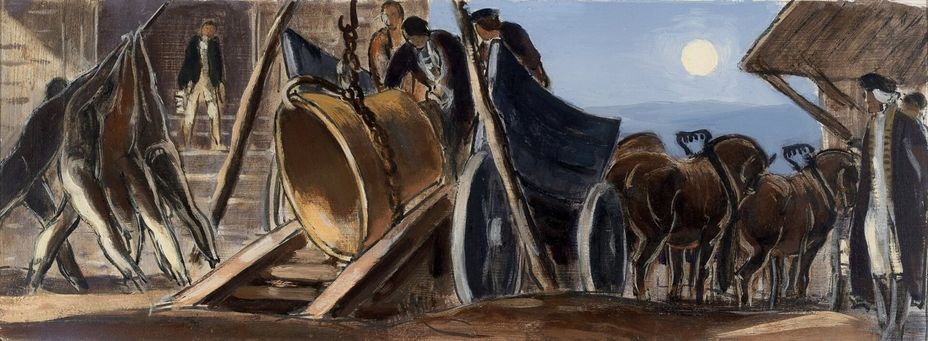
In September 1777, the war was going badly for the patriots around Philadelphia. The British beat Washington's army at the Battle of Brandywine in Chester County, and the city was about to fall. People were afraid the British would take the city's bells and melt them down for ammunition. So the bells came down. The State House bell, the one we now call the Liberty Bell, was one of eleven that left Philadelphia.
They traveled by horse and wagon, north through Quakertown and into Bethlehem, and the trip ended at Zion's Reformed Church in a small crossroads town that was then called Northampton Towne. That town is Allentown. When the new bell was unveiled out front in May, James Higgins of the Lehigh County Historical Society told WFMZ the Liberty Bell was hidden here only 15 years after the town was officially founded, and he called it the origin story of Allentown. I'd never thought of it that way, and now I can't stop.
Under the floorboards at Zion's
The church hid the bells under the floorboards of its basement. Why Zion's, and why this town? Nobody knows for sure. Jill Youngkin, chief curator at the Lehigh County Historical Society, told Lehigh Valley Public Media she doesn't know "100 percent why," and her best guess is the size of the church. It was a big church, she said, and a good place to hide something the size of the Liberty Bell. I kind of love that the honest answer comes down to the basement being big enough.
The bell stayed at Zion's until the British cleared out of Philadelphia. The Historical Society dates its stay from September 1777 to June 1778. Then it went home to the State House, the building we call Independence Hall, and Allentown went back to being a small town that had briefly kept a very large secret.
The shrine downstairs
For a long time, the hiding place at Zion's was mostly a line in the history books. Then in 1962 the church basement became the Liberty Bell Shrine Museum, with exhibits on the bell and a full-size replica that visitors were allowed to ring. The Historical Society says plenty of lifelong Lehigh Valley people remember ringing it. It also says the museum became the home of Pip the Mouse, the puppet show that started at Hess's Department Store, after Hess's closed. That's a lot of Allentown childhood packed into one church basement.
The shrine closed in 2023, when the church building was sold. Its collections, Pip included, moved a few blocks away to the Lehigh Valley Heritage Museum on West Walnut Street. The replica bell did not make the trip. It's still in the lower level of the church, which isn't open to the general public. Lehigh Valley Public Media reported the replica was cast in France in 1950 and presented to Pennsylvania. Former Lehigh County Executive Phil Armstrong, who worked on moving the museum's artifacts, told the outlet the state owns the replica and it couldn't be moved without the state's approval. Then he added, "They say that part of the church was built around the bell." Whether or not that's literally true, it's the most Allentown way possible for a bell to refuse to leave.
The building now belongs to Resurrected Life Community Church. Its pastor told Lehigh Valley Public Media that people still light up when they see the bell downstairs, and that "here, you can touch it and ring it."
A bell for the corner
That brings us back to the sidewalk. On May 7, 2026, America250PA, the state commission planning Pennsylvania's part of the country's 250th birthday, unveiled a bronze Semiquincentennial Bell at the corner of Hamilton and South Church Street, a few feet from where the real one hid. It's more than six feet tall and about 1,500 pounds of bronze. The $250,000 price tag was mostly covered by donations. According to the state Senate's announcement of the unveiling, these commemorative bells are modeled on the replica Queen Elizabeth II gave the United States for the 1976 Bicentennial, and Allentown's was the fourth to go up around Pennsylvania.
It's a strange thing to stand next to. The real bell spent its time here out of sight, under a floor, in the dark. The new one is out on the corner where anybody walking down Hamilton can look at it.
Go see it
You can see the new bell any time from the Hamilton Street sidewalk between Sixth and Seventh. For the full story, the Lehigh Valley Heritage Museum at 432 W. Walnut St. has an exhibition on the American Revolution that pulls in displays from the old shrine alongside its own collection, including the Lehigh Valley's part in the war. The museum is open Tuesday through Saturday, 10am to 4pm. Check admission on its website before you go.
Philadelphia got the Liberty Bell back. Allentown kept the story, and now it finally has a bell out front to tell it.